


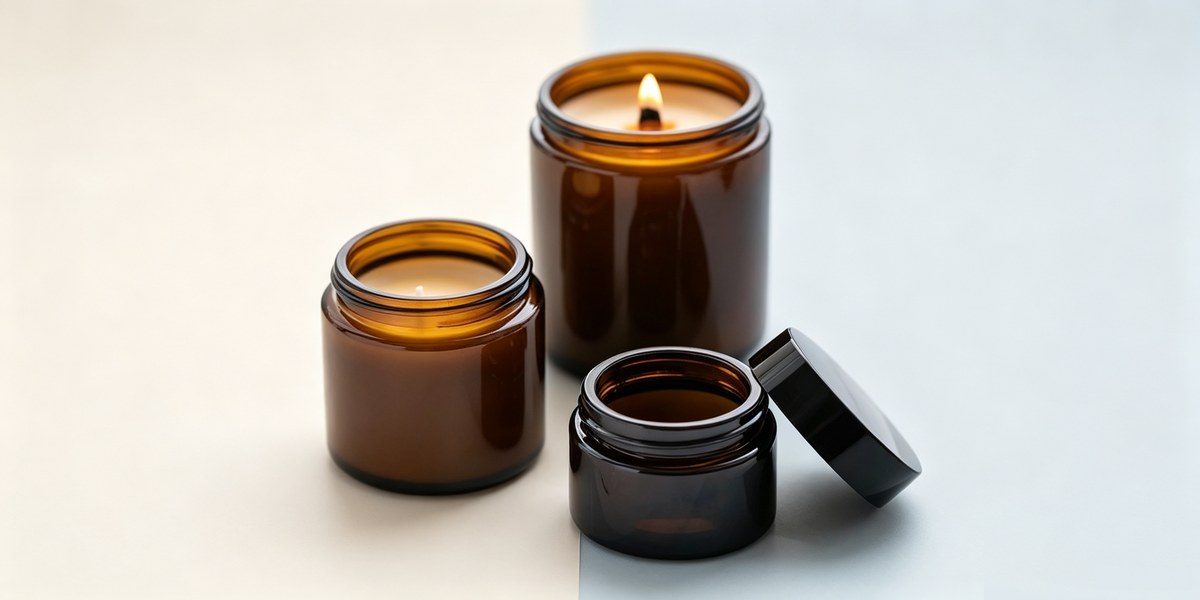
Buyer's Guide
What Are Amber Glass Jars? Uses, Benefits & Buying Guide
Amber glass jars are brown-tinted containers that protect light-sensitive products. Here's how to choose the right size, neck finish and cap.
Aug 19, 2026
Choosing a dropper bottle looks simple until you are the one placing a 20,000-piece order. Glass colour, closure type, pipette material and neck finish all change how your product behaves on the shelf — and what it costs you. This guide walks through every decision a buyer actually has to make.
Dropper bottles are measured in millilitres, but the right size depends far more on how the product is used than on how much liquid it holds. Here is how the industry generally breaks down:
| Size | Typical use | Why buyers pick it |
|---|---|---|
| 5 ml | Samples, single-blend oils, roller refills | Lowest unit cost, fits sample programmes and gift sets |
| 10 ml | Pure essential oils, serum travel size | The most common retail size for neat oils |
| 15 ml | Facial oils, beard oils | Roughly one month of daily use |
| 30 ml | Tinctures, CBD oils, serums | Standard for dropper-based dosing products |
| 50–100 ml | Refill sizes, professional use | Better value per ml, used by clinics and spas |
A practical rule: if your customer applies the product a drop or two at a time, 10–30 ml is almost always right. Anything larger and the oil oxidises before it is finished.
Glass colour is not decoration. It controls how much light reaches the product, and light is the main reason essential oils and CBD formulations degrade.
If you are unsure, amber is the safe answer. Very few buyers regret choosing amber; many regret choosing clear.
A dropper bottle is three parts working together — the bottle, the dropper assembly (collar + rubber bulb + pipette) and the outer cap. Each has options:
Required in many markets for CBD, cannabis and certain tinctures. A CR dropper needs a push-down-and-turn motion to open. They cost slightly more, but they are the difference between a compliant product and a recalled one.
A ring at the base of the collar breaks visibly on first opening. For supplements and ingestible tinctures, retailers increasingly demand it.
Glass pipettes suit most oils and do not react with citrus or high-terpene blends. Plastic pipettes are cheaper and safer for shipping, but can cloud with certain formulations. Graduated pipettes (marked at 0.25 / 0.5 / 0.75 / 1.0 ml) help customers dose accurately and are popular for tinctures.
Dropper bottles commonly use 18 mm or 20 mm neck finishes. The neck must match your dropper assembly exactly. This sounds obvious, but mismatched necks are the single most common reason a first order has to be re-made. Always confirm the finish in millimetres and, if possible, test-fit a sample closure before committing to a production run.
Not every oil bottle needs a dropper. An orifice reducer is a small plastic insert that restricts flow to a controlled drip. It is cheaper than a dropper assembly and suits products the customer pours or dabs rather than measures. Many brands use droppers on 10–30 ml retail sizes and orifice reducers on 50–100 ml refill sizes.
Once the functional choices are settled, decoration turns a stock bottle into your packaging:
Silk-screen printing has a plate cost, so it suits runs above about 3,000 pieces. Below that, labelling is usually more economical.
| Product type | Suggested bottle | Closure |
|---|---|---|
| Neat essential oil | 10 ml amber | Dropper + tamper band |
| Facial serum | 30 ml amber or frosted | Dropper, graduated pipette |
| CBD tincture | 30 ml amber | Child-resistant dropper |
| Beard / hair oil | 15–30 ml clear or amber | Dropper or orifice reducer |
| Refill / professional | 100 ml amber | Orifice reducer + screw cap |
"Nice seals. The glass is heavy with sturdy lids, just as described. Worked great for our needs — we would buy again."
"I’m happy with everything — no complaints at all. Shoutout to the supplier and the workers, very good job!"
Prefer to buy through a platform? Find our verified storefronts below — same factory, same factory-direct pricing.
Buyer guides and packaging know-how from the Eaglebottle team.
Amber glass jars are brown-tinted containers that protect light-sensitive products. Here's how to choose the right size, neck finish and cap.
Sticky, cold or crystallized material can be hard to remove. These techniques protect your jars and your product.
From specialty manufacturers to packaging factories — what to check before ordering borosilicate glass for your products.
A clear, repeatable process — so you always know what happens next and when your shipment leaves.
Tell us your sizes, quantities and decoration ideas — free samples are available before you commit.
Contact Us Today