


Buyer's Guide
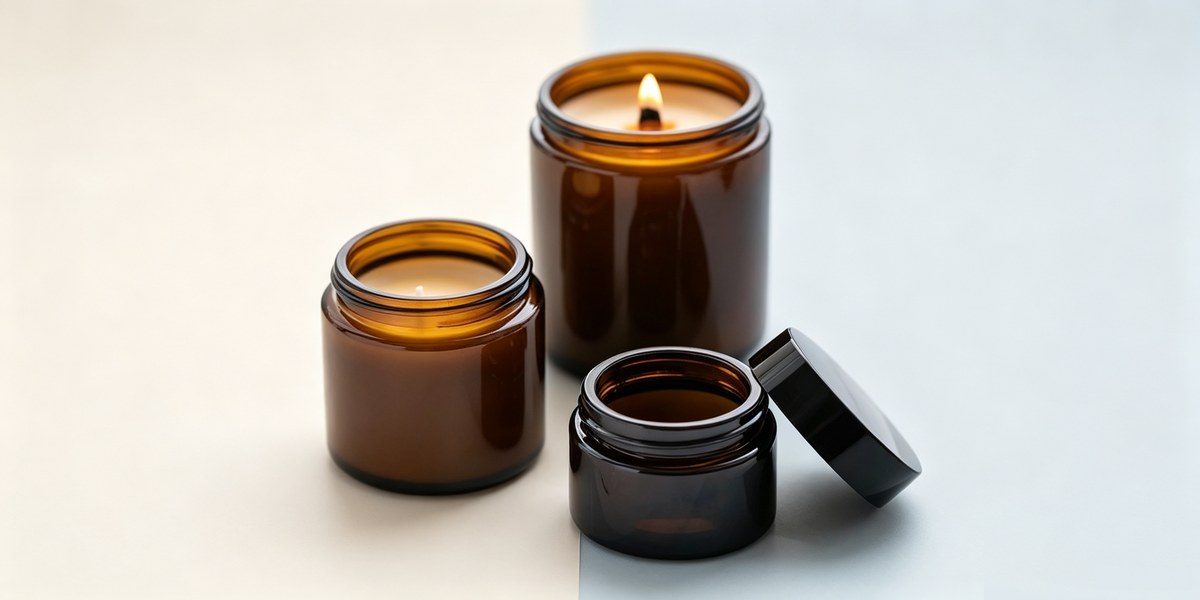
What Are Amber Glass Jars? Uses, Benefits & Buying Guide
Amber glass jars are brown-tinted containers that protect light-sensitive products. Here's how to choose the right size, neck finish and cap.
Aug 19, 2026
Why do most perfumes come in 50 ml or 100 ml? And when does a 10 ml or a 150 ml bottle make commercial sense? This guide explains what each size is really for, how it affects your pricing, and which closure to pair with it.
| Size | Best for | Sprays (approx.) | Typical position |
|---|---|---|---|
| 10 ml | Travel, discovery sets, samples | ~100 | Entry / gift |
| 15 ml | Purse spray, limited editions | ~150 | Impulse |
| 30 ml | Everyday personal, first purchase | ~300 | Entry retail |
| 50 ml | The industry standard | ~500 | Core SKU |
| 100 ml | Value size, signature scent | ~1,000 | Core SKU |
| 150 ml+ | Home fragrance, shared use | 1,500+ | Niche / value |
Small bottles serve two very different jobs. As discovery sizes, they let customers try a scent before committing — a proven way to lift full-size conversion. As travel sizes, they must be genuinely portable, which usually means a screw or crimp collar that will not leak in a bag.
At this size, decoration matters more than volume. A well-finished 10 ml bottle in a discovery set often sells the brand better than a plain 50 ml.
Thirty millilitres is where a fragrance becomes a daily object. It suits customers who want one good scent rather than a collection, and it is a common size for niche and independent houses because it keeps the shelf price accessible while preserving margin.
Pair 30 ml with a fine-mist sprayer — at this size customers expect a spray, not a dabber.
These two sizes carry most of the fragrance industry. The reason is behavioural: 50 ml suits someone who wears several scents, 100 ml suits someone with one signature scent. Offering both is standard practice, with 100 ml priced at roughly 1.4–1.6× the 50 ml rather than double — a deliberate nudge toward the larger size.
At these volumes, spray quality becomes critical. A fine, even mist is what customers notice most, and it depends on the pump as much as the bottle.
Large formats are usually positioned as shared or home fragrances, or as limited "collector" editions. They are also popular for body mists and room sprays, where the cost per ml matters more than portability.
| Closure | How it works | Best for |
|---|---|---|
| Crimp sprayer | Pump crimped permanently onto the neck, covered by a decorative cap | Premium retail fragrance (30–150 ml) |
| Screw collar sprayer | Threaded pump, refillable and replaceable | Refill lines, travel sizes, body mist |
| Roller ball | Steel or glass ball, no spray | Oil-based perfume, 5–15 ml |
| Dabber / open neck | Simple stopper, no atomiser | Attars, traditional formats |
The neck finish (commonly 13 mm or 15 mm crimp, or an 18/415 screw neck) must match your chosen pump exactly. Confirm this with samples before a production run — it is the most common cause of costly rework.
Heavier glass reads as more expensive. A thick base and substantial walls raise both perceived value and actual shipping weight. As a rule:
Popular shapes at each tier: slim cylinders and rounds for 10–30 ml; flat-shoulder squares and heavy-based rounds for 50–100 ml; wide cylinders for 150 ml+.
A practical starter range for a new fragrance line:
Add 30 ml once you understand whether your customers buy one scent or several. Hold off on 150 ml until the brand has a defined signature scent.
"Nice seals. The glass is heavy with sturdy lids, just as described. Worked great for our needs — we would buy again."
"I’m happy with everything — no complaints at all. Shoutout to the supplier and the workers, very good job!"
Prefer to buy through a platform? Find our verified storefronts below — same factory, same factory-direct pricing.
Buyer guides and packaging know-how from the Eaglebottle team.
Amber glass jars are brown-tinted containers that protect light-sensitive products. Here's how to choose the right size, neck finish and cap.
Sticky, cold or crystallized material can be hard to remove. These techniques protect your jars and your product.
From specialty manufacturers to packaging factories — what to check before ordering borosilicate glass for your products.
A clear, repeatable process — so you always know what happens next and when your shipment leaves.
Tell us your sizes, quantities and decoration ideas — free samples are available before you commit.
Contact Us Today