


Buyer's Guide
How to Choose the Right Dropper Bottle for Essential Oils
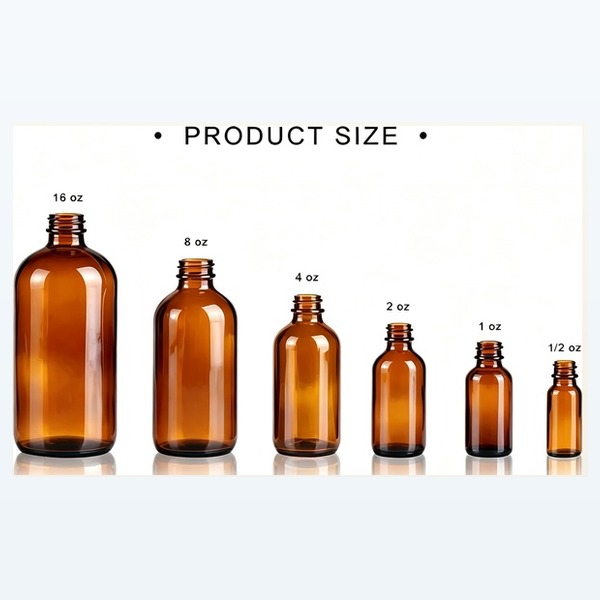
Sizes from 5 ml to 100 ml, amber vs cobalt vs clear, child-resistant closures and neck finishes.
Sep 13, 2026
Amber glass is the default package for anything that degrades in light — essential oils, CBD tinctures, botanical extracts, laboratory chemicals and a long list of cosmetics. It is also one of the most frequently mis-specified materials in the category: buyers order "amber jars" without knowing that amber is a colour range rather than a colour, how much ultraviolet light the glass actually blocks, or how much batch-to-batch variation is normal. This guide covers what amber glass is, what it does and does not protect, the sizes and finishes that exist in stock moulds, and how to write a specification a factory can hold to.
Amber glass is not coated, and it is not tinted after the fact. The colour is in the melt: iron oxide and sulphur compounds are added to the batch, and the resulting glass absorbs light in the ultraviolet and short-wavelength visible range. Because the colour comes from the glass chemistry itself, it cannot flake, wear through or degrade the way a sprayed lacquer, a shrink sleeve or a printed label can.
Two things follow from that. First, an amber jar is amber through its entire wall thickness — chip it and the fracture is amber too. Second, the shade is a batch variable. The same mould filled from two different melts will produce two slightly different browns, which is why "amber" in a catalogue describes a family of shades rather than a single colour. If colour consistency matters to your brand, say so in the specification and ask for retention samples from the production run; that turns an argument at goods-in into a measured check against an agreed reference.
This is where most of the misinformation sits. Amber glass is highly effective against ultraviolet light in the range that drives most photodegradation, but it is not opaque. It transmits a meaningful share of longer-wavelength visible light, and the numbers depend on wall thickness — a 2 mm wall and a 5 mm wall of the same colour are two different optical filters.
| Glass type | UV protection | Visible light | Typically used for |
|---|---|---|---|
| Amber | Very high in the UV-B and near-UV range | Blocks most; transmits deep orange-red | Oils, tinctures, extracts, chemicals, pharmacy |
| Clear flint | None | Fully transparent | Beverages and decoration, where visibility sells |
| Cobalt blue | High, in a narrower band | Transmits blue-violet | Premium presentation with real light protection |
| Frosted / acid-etched | Low to moderate — scatters light, does not filter it | Diffused | Aesthetics; pair with amber or an opaque finish if protection matters |
| Opaque (coated or sleeved) | Effectively total | None | Photosensitive actives, flower, high-value retail |
The practical rule: amber is the right default for most light-sensitive liquids. But if the formulation is genuinely photosensitive — and especially if it will sit on a lit retail shelf for months — shorten the exposure and consider an opaque or sleeved option rather than trusting colour alone. For a side-by-side treatment of the three common colours, see Amber vs Cobalt Blue vs Clear Glass: Which Do You Need?
| Product | Typical capacity | Why amber |
|---|---|---|
| Essential oils and aromatherapy blends | 5–100 ml | Citrus and terpene-rich oils oxidise quickly in light |
| CBD and THC tinctures, MCT oils | 15–60 ml | Cannabinoids degrade under UV; amber also signals the category |
| Botanical and herbal extracts | 30–250 ml | Protects volatile actives across a long shelf life |
| Cosmetic serums, facial oils, actives | 15–100 ml | Retinol, vitamin C and many actives are light-labile |
| Salves, balms and body butters | 30–250 ml | Light protection plus a natural, apothecary look |
| Laboratory and chemical samples | 30–1000 ml | Standard practice for light-sensitive reagents |
| Cannabis concentrates (secondary pack) | 5–15 ml | Where CR rules allow, amber supports the concentrate aesthetic |
| Honey, syrups and speciality foods | 100–500 ml | Protects natural colour and delicate flavour compounds |
Amber jars cluster around the same capacity range as clear jars, but the stock selection is narrower — amber is a speciality melt, so fewer moulds run in it. That has two consequences: MOQ is often lower on an existing amber mould than on a new one, and tooling an amber jar in a fresh size is a much larger commitment than ordering an existing clear mould in the same capacity.
| Capacity | Common neck finish | Typical closure |
|---|---|---|
| 5–15 ml | 13–18 mm | Screw cap, dropper, CR cap on 18 mm finishes |
| 15–30 ml | 18–20 mm | Dropper, CR dropper, screw cap |
| 30–60 ml | 20–24 mm | Dropper, CR cap, screw cap |
| 60–120 ml | 38–48 mm | Screw cap, lug cap, CR cap |
| 120–250 ml | 53–63 mm | Screw cap, CR cap, aluminium lid |
| 250–500 ml | 63–82 mm | Screw cap, lug cap, wide-mouth options |
Cross-check the finish against your closure supplier before you commit. The finish must match a cap that is actually stocked, and if you need a certified child-resistant closure, the finish has to be one the CR cap is certified on — the two decisions are linked, not independent.
"Nice seals. The glass is heavy with sturdy lids, just as described. Worked great for our needs — we would buy again."
"I’m happy with everything — no complaints at all. Shoutout to the supplier and the workers, very good job!"
Prefer to buy through a platform? Find our verified storefronts below — same factory, same factory-direct pricing.
Buyer guides and packaging know-how from the Eaglebottle team.
Sizes from 5 ml to 100 ml, amber vs cobalt vs clear, child-resistant closures and neck finishes.
Product stability, barrier properties, brand perception, shipping cost and real unit economics.
What each size is really for, spray counts, crimp vs screw closures and how to plan your range.
Nine stages, the documents you need, landed cost and the five costly mistakes.
Typical minimums by product, price tiers and five ways to lower your MOQ.
Capacity vs brimful, neck finishes like 18/415, tolerances and closure fit.
16 CFR 1700, ASTM D3475 and Health Canada requirements side by side.
What the test panels measure, closure classes, and what to demand from suppliers.
Sizing, glass type, airtight seals and the North American compliance checklist.
UV protection, cost and shelf appeal compared — plus a decision framework.
Sizing, glass vs silicone, CR closures and how to cut product left in the jar.
Neck finish codes like 53-400, liner selection and how to test a seal.
A clear, repeatable process — so you always know what happens next and when your shipment leaves.
Tell us shape, capacity, quantity and decoration. We send a detailed quote within 24 hours.
Stock samples ship in 3 days; custom pre-production samples in 7–15 days, so you can test before ordering.
5 furnaces and 12 lines run your order, with automatic inspection plus SGS/ISO checks — photos and reports before shipment.
Export cartons and pallets, FOB Shanghai / Qingdao / Ningbo, or DDP straight to your warehouse.
Tell us your sizes, quantities and decoration ideas — free samples are available before you commit.
Contact Us Today